

Feedback is the best way to collect and analyse information about employees’ skills, behaviour, and work performance within an organization. A well-designed feedback process is a tool for learning and development that enables both the organization and the employee to grow together. It is essential that feedback is constructive, balanced, and delivered in a way that supports development rather than creating fear or tension.
The purpose of collecting feedback is to provide both the employee and the organization with a clear overview of an individual’s strengths, development opportunities, and role within the team and the organization as a whole.
360-degree feedback is a method in which an employee’s skills and behaviour are evaluated by as many relevant parties as possible. Feedback is provided by all stakeholders who are professionally connected to the person being assessed, both within and outside the organization.
Participants:
360-degree feedback is particularly suitable for the development of leaders and key roles. While the method requires time and organizational readiness to invest in the process (communication, selection of assessors, follow-up actions), it provides the most comprehensive and well-rounded view of the individual.
270-degree feedback is similar to the 360-degree model, but feedback is collected only from internal stakeholders within the organization.
Participants:
This method is suitable when it is not possible to involve all roles or when the focus of the assessment is more limited. The key principle to follow is that the quality of feedback is more important than the number of assessors or roles involved. Like the 360° model, 270-degree feedback requires thoughtful planning (communication, selection of assessors, follow-up actions).
180-degree feedback is a two-way model that typically involves the employee and their manager.
Participants:
This model is easy to integrate with development discussions. The assessment can be conducted either as a separate questionnaire or as part of the development discussion itself. In the latter case, it is important to ensure that both the employee and the manager have sufficient time to cover all relevant topics thoroughly.
This type of two-way feedback is also well suited to internship supervision processes, where the person being assessed is an intern and the assessors are the intern and the supervisor. Feedback can be given on both the organization of the internship and the activities of the intern and the supervisor.
In some cases, the primary goal is to support self-analysis. Self-assessment is mainly used to encourage self-reflection and personal development. For example, it can be used as part of a development discussion or a 1:1 meeting, in leadership development programmes, or when creating an overall development and training plan.
It is also possible to conduct one-sided assessments, where the employee does not self-assess and feedback is collected from only one party (e.g. only from a manager or only from colleagues).
No method is inherently better or worse — suitability depends on the goal, organizational culture, and available resources.
Method | Participants | Primary use case | Advantages | Drawbacks or risks |
360° | The employee being assessed, manager, colleagues, subordinates, assessors from outside the organizationi | Development of leaders and key employees | Most comprehensive overview; strong input for developing leadership behaviour | Higher time investment and process workload (especially in follow-up activities) |
270° | The employee being assessed, direct manager, either colleagues or subordinates | Development of leaders and key employees; specialists and team members | Broad perspective; less resource-intensive than 360° | Time and process demands; selection bias (assessments by “friendly” raters) |
180° | The employee being assessed and their direct manager | Performance management, expectation alignment, development discussions, role goals and competencies | Simple and fast; low workload; suitable even for less mature feedback cultures | Single-source bias; outcome depends heavily on manager quality; more limited view of collaboration |
Feedback questionnaires are typically competency- and behaviour-based, focusing on how a person performs in their role rather than what they do.
A feedback questionnaire usually consists of 5–6 core competencies, each broken down into sub-competencies (statements or behavioural indicators).
Organizations can use publicly available competency models (e.g. the competency model for middle managers in the public sector developed in cooperation between the Estonian Ministry of Finance and LevelLab OÜ) or create a competency model tailored to their own organization.
Recommended structure:
Scale selection:
The “Unable to assess” option is important when it is known that assessors may not have sufficient exposure to the employee’s activities or competencies.
At the same time, it is important to ensure that “Unable to assess” does not become a convenience option — if used too frequently, the employee may miss out on valuable feedback.
In addition to rating scales, it is essential to provide space for open-ended comments in the questionnaire (e.g. asking for examples of past behaviour, suggestions for improvement, what the employee does particularly well, and what could be done differently). These qualitative comments are often the most valuable part of the feedback for the recipient.
Feedback can be collected either anonymously or with names attached. As a general principle, when colleagues, subordinates, or external partners are involved, anonymity helps ensure more honest feedback. The final decision depends on organizational culture, the purpose of the assessment, and internal agreements.
When organizational structures and roles are already mapped, launching the feedback process is much simpler: the feedback recipient (the person being assessed) and the people providing feedback (assessors) are defined. Roles are assigned according to the structure or adjusted as needed.
Each feedback recipient receives an aggregated overview of their strengths and development opportunities. The individual summary report highlights differences between self-perception and how others perceive the individual.
A good report provides a clear overall picture as well as insights into patterns that emerge across different roles. Seeing average results across all participants in the assessment also allows each recipient to understand how their results compare with the overall group.
Open-ended comments add particular value: concrete examples and suggestions give meaning to numerical ratings and help define the next development steps.
The self-assessment and the direct manager’s feedback are not anonymous. Although there is sometimes a desire to “blend” the manager’s assessment into peer feedback, common and effective practice is to keep the manager’s feedback clearly identifiable. This makes it easier for the employee to understand expectations, gain clarity on strengths and development areas, and agree on concrete next actions.
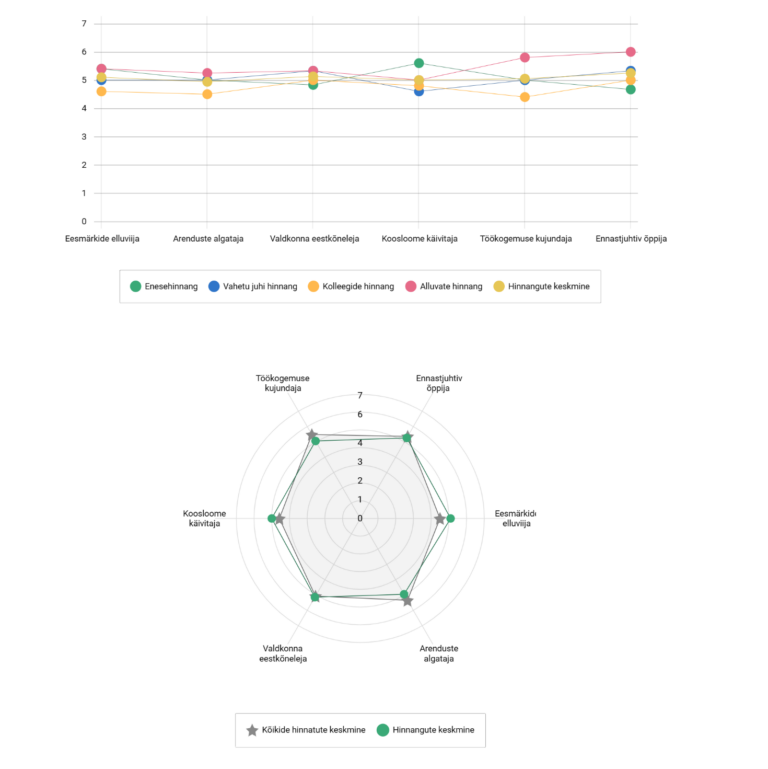
The real value of feedback lies in the follow-up actions. It is important to think before sending out questionnaires about how the results will be used, what follow-up activities will take place, and who will support the interpretation of the results. Employees should never be left alone with their feedback reports — especially when feedback comes from multiple roles and reflects different perspectives.
Practical options to consider when interpreting results and supporting development plans include:
1:1 discussions between the manager and the employee being assessed
Reviewing results as part of development discussions
Involving an external partner (e.g. a development coach or trainer) to help interpret the results
In larger organizations, internal support (a coach or HR partner) to help define focus areas and implement the development plan
PlanPros provides everything needed to conduct 180°, 270°, and 360° feedback assessments and to link competency evaluation with development discussions.
Article authors: Reelika Ristolainen ja Riina Truusalu.
If you would like to implement a 180°, 270°, or 360° feedback assessment in your organization (or link competency evaluation with development discussions), please get in touch.
Follow us on social media:
Please fill in the contact form and we will contact you.
Please fill in the contact form and we will contact you.

Tarkvara võimalusi tutvustab Sulle
Reelika Ristolainen, kliendihaldur-tootekonsultant

