
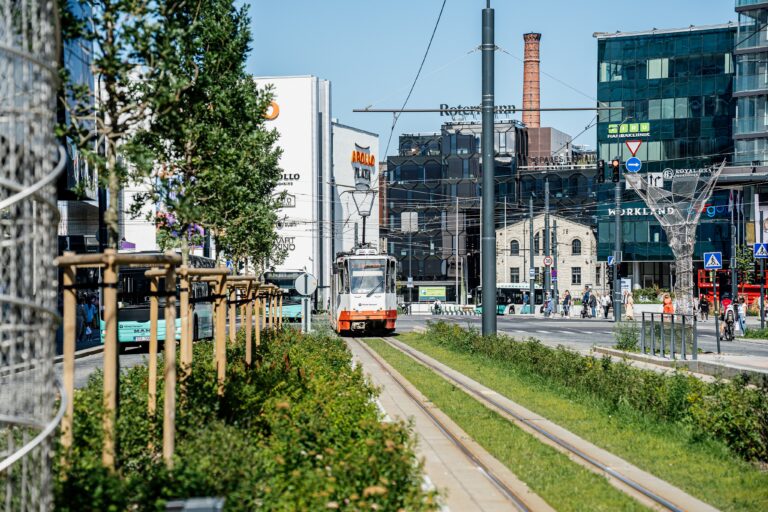
The author of the article, Andres Kukk, is the Development Manager of the Tallinn Transport Department, whose focus is on supporting the systematic development of the board’s services, processes and digital capabilities.
The role of the Tallinn Transport Department in the functioning of the city of Tallinn is critical – we organize the ordering and management of services related to the city’s mobility: traffic management, public transport, parking and several developments and procurements that keep the city moving on a daily basis. In essence, we influence the mobility experience of hundreds of thousands of people every day.
My previous work experience comes from an organization where the company’s strategy – the activities, processes and work organization supporting its implementation – were clearly structured and documented. When I started as a department manager at the Tallinn Transport Department 1.5 years ago, the first question for me was: what is my goal and how is it related to the organization’s strategy?

I noticed that people did their work with great dedication, but the systematic framework and the use of digital tools supporting it were uneven. There were situations where:
the same task was solved in several departments without knowing that others were doing it.
In terms of digital tools, the main focus was on solutions offered by Microsoft. There is nothing wrong with that in itself – Microsoft’s cloud solutions are very good (says a convinced Apple user). But every ensemble sounds better when they play to the same note.
At one point, I received information that Tallinn had chosen software called PlanPro to monitor development plans. In our office, it had been tested in some departments, but it was not yet in daily use. I started testing it in my own department. At first, as a user with a background in Jira, ClickUp and Trello, it took me a while to understand the logic of the system. Within a couple of months, our department had a clear work plan and we used it to plan our weekly activities.
Based on previous experience, I know that implementing a new way of working in an entire organization only works well if there is support from managers. I consistently started inspiring my colleagues – other department heads and my manager – to implement a uniform work organization. I gave examples of what and how it could be done and what the benefits of such an approach could be for everyone. About six months after starting in my department, we came up with the first version of the sectoral work plan for public transport management. That was the moment when I received confirmation that we were moving in the right direction.
Implementing a new way of working in an entire organization will only be successful if there is support from managers.
Today, the vast majority of employees in our department are already actively using PlanPro – including several colleagues who have chosen this environment as their so-called to-do tool.
When ordering a specific service, we set ourselves the goal of implementing value-based procurement – ordering a service based on working hours instead of a specific result. There are certain risks associated with such a contract. To prevent these, we applied a simplified version of the Scrum methodology known from the IT development world to order work and used PlanPro to document the entire process. This way, we were essentially able to monitor budget execution, volume estimates given for the execution of work, their explanations, and later logged the actual time spent on performing the work in real time.
This approach disciplined the entire project team. While there was some confusion and doubts at the beginning, by the time the next procurement was planned, the feedback from the clients was positive: the chosen working method increases transparency and helps to better ensure that money is used for its intended purpose.
The greatest value of PlanPro is the information architecture that supports the management model, which helps create a common “field of truth.” While previously there was a parallel world of documents and meetings, now a common structure is gradually emerging, where goals, activities, and responsibilities are visible to everyone.
Tallinn Transport Department is a unit of the city of Tallinn, whose task is to ensure smooth and safe mobility on the streets of the capital. The board manages and develops the city’s transport system, based on the “Tallinn 2035” development strategy, which aims to make urban space more people-friendly and mobility more environmentally sustainable.
Today, the agency employs 53 specialists who work to ensure that the mobility experience of hundreds of thousands of people in Tallinn is comfortable and predictable.
Read more about PlanPro project management and task management and see how PlanPro can support the management in the Public Sector.
If you are looking for the right software to take your organization’s project and task management to the next level, feel free to get in touch!
Follow us:
Please fill in the contact form and we will contact you.
Please fill in the contact form and we will contact you.

Tarkvara võimalusi tutvustab Sulle
Reelika Ristolainen, kliendihaldur-tootekonsultant

